

Winter-proof your entranceway
Why matting matters when salt and grit hit the floor.
Every winter, your front door becomes the busiest cleaning problem in the building. Rain, sleet, slush, road salt and gritting sand all arrive on the soles of shoes, and most of it ends up on your floors within the first few steps.
The good news is that the fix is simple and relatively cheap. A properly specified winter entrance matting system stops the bulk of that dirt and water at the door. It protects your flooring investment and, more importantly, keeps the people walking through your building on their feet.
Salt and grit: the hidden cost to your floors
Gritted pavements and car parks keep people upright outside, but what makes them safe outdoors is destructive indoors. Rock salt is mostly sodium chloride crystals, and it is often mixed with sharp sand to spread further and give extra grip. Once walked inside, that mixture does three kinds of damage.
- It acts like sandpaper. Salt crystals and sand particles are micro-abrasives. Every footstep grinds them into the floor, scratching sealed timber, dulling polished stone and terrazzo, and wearing through the protective finish on vinyl and safety flooring. Matting suppliers often cite the claim that an unprotected floor can lose a large share of its finish in the first couple of metres inside the door after only a few thousand footfalls. Whatever the exact figure, the first few metres inside the door wear out fastest.
- It leaves a residue that is hard to shift. As wet salt dries it leaves the familiar white haze on hard floors. Some de-icers, particularly calcium chloride, can leave a greasy film instead. They also draw moisture from the air, so affected carpet and matting can stay damp and attract more dirt. Ordinary alkaline detergents can make the problem worse, so salt residue often needs a dedicated neutralising cleaner.
- It attacks the finish and the material underneath. Salt can strip the lacquer or oil from wooden floors, leaving the timber open to water damage. On laminate, moisture that reaches the core can cause swelling. Natural stone such as marble and limestone can etch and stain. Carpets turn stiff and gritty, and the fibres wear out faster.
The result is shorter floor life, more frequent deep cleaning and earlier refurbishment. All of it starts at the front door.
Wet floors: the slip hazard on your doorstep
Slips, trips and falls on the same level are the most common causes of nonfatal workplace injury in Great Britain. HSE’s 2024/25 figures put them at 30% of non-fatal injuries to employees, out of around 680,000 self-reported workplace injuries. Those figures cover staff only. Customers, visitors, patients and pupils slip on the same floors.
Most slips happen when a floor is wet or contaminated, and in winter the entranceway is where that contamination arrives. Even a thin film of water on a smooth floor can sharply reduce grip underfoot. Add a gritty, salty slurry and dark mornings when people are hurrying in out of the cold, and the first few metres inside the door become one of the highest-risk areas in the building.
There is a legal dimension too. Under the Workplace (Health, Safety and Welfare) Regulations 1992, floors must be kept free, so far as is reasonably practicable, of substances that could cause someone to slip. Building owners and occupiers also owe a duty of care to visitors. A wet, unmatted entrance is a foreseeable hazard, and that is hard to defend after someone has been hurt.
HSE’s own case studies show what good practice looks like. One supermarket with a smooth floor laid extra matting at its entrance in wet weather to create a large, continuous shoe-drying surface. Staff swapped wet mats for dry ones through the day and dry-mopped any water that got past.
How winter entrance matting stops the problem at the door
A single doormat is not enough in winter. Effective entrance matting works as a system of three zones, each doing a different job as people walk in.
- Scraper zone (outside or in the doorway). A coarse, open mat made from rubber, aluminium or coir knocks off grit, salt crystals, mud and slush. Open or recessed designs let debris and water drop below the walking surface so it is not picked up again.
- Scraper-wiper zone (the lobby or vestibule). A combination mat continues to remove fine grit while starting to absorb water from shoe soles.
- Wiper or drying zone (just inside). A dense, absorbent textile mat soaks up the remaining moisture and fine particles, so shoes are close to dry by the time they reach the main floor.
Length matters more than most people think. The aim is to get several footfalls on each foot before people step off the matting. Industry guidance broadly agrees on the following, though exact figures vary by supplier and product:
| Matting length (direction of travel) | Approximate dirt and moisture removed |
| 2 metres | Around 40% |
| 4 metres | Around 65–70% |
| 6 metres | Around 85–90% |
Many UK entrances have only 2 to 3 metres of matting, which leaves most of the wet and grit to land on the floor beyond. For busy entrances, around 6 metres is a sensible target. If space is tight, a recessed mat well, a canopy or a second set of doors can add useful length.
Getting winter entrance matting right: a practical checklist
The best matting in the world fails if it is in the wrong place, the wrong size or left to saturate. Before the worst of the weather arrives, check the following.
- Cover the route people actually take. Mats should run the full width of the doorway and follow the natural walking line, so nobody can step around them.
- Choose the right mat for each zone. Use coarse, open scraper mats outside and absorbent wiper mats inside, not one general-purpose mat for everything.
- Make sure mats lie flat and stay put. Curled edges, rucked corners and sliding mats are trip hazards in their own right. Use bevelled edges, anti-slip backing or recessed mat wells.
- Plan for heavy days. Keep spare dry mats ready to swap in when the primary mats become saturated during prolonged rain or snow.
- Clean mats as often as the floor. Vacuum textile mats daily in winter, and empty or hose down scraper mats and mat wells regularly. A mat full of salt and grit is just passing it on.
- Watch for wet footprints. If footprints continue past the end of the matting, the system is too short or too wet. Add length or change mats more often.
- Back it up with good housekeeping. Keep wet-floor signs and a dry mop near the entrance, and clear water promptly when it gets past the mats.
- Think about accessibility. Very deep pile or aggressive scraper surfaces can be hard going for wheelchairs, pushchairs and some assistance dogs. Choose low-profile products that everyone can cross easily.
Let the experts lift, launder and lay
The hardest part of winter entrance matting is keeping it working. A mat that is clogged with salt and grit, or saturated after a week of rain, stops protecting your floor and can start spreading the mess instead. That is where a managed matting service earns its keep.
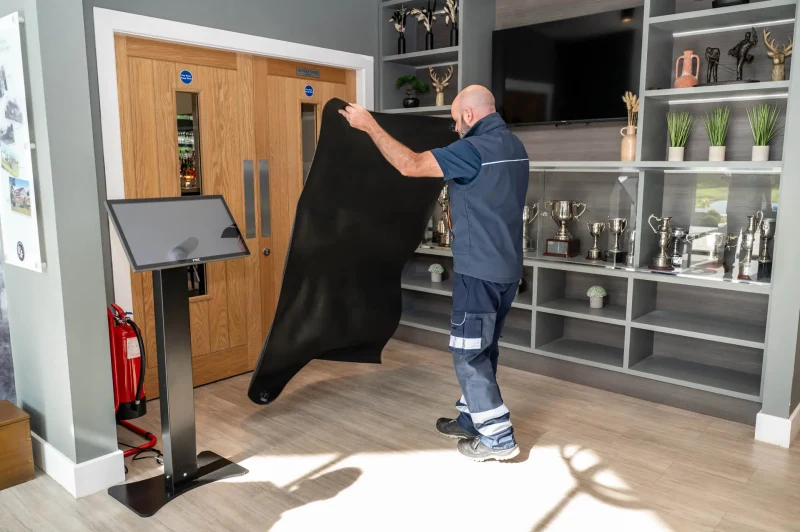
Wilson Washroom Services offers a bespoke lift, launder and lay winter entrance matting service for businesses across Scotland and the North East of England. Our engineers lift soiled mats and lay freshly laundered replacements every one to two weeks, or on a schedule set around your site, so your entrance is never left to cope with a worn-out mat. Through winter, you can increase the frequency to match the weather.
Our winter entrance matting is:
- Built to do the job. A high-twist nylon pile lifts dirt and moisture from shoes: each mat can hold up to 6 kg of dirt and 3 litres of water, and well-placed, regularly serviced mats can stop over 70% of tracked-in dirt and moisture.
- Safer underfoot. Rubber backing keeps mats durable, and optional Raptor anti-slip backing stops them creeping on tiled or marble floors. The mats are also fire retardant.
- Sized and branded for you. Mats come in a range of sizes and colours, and Wilson Washrooms’ in-house design team can produce custom logo mats in your brand colours, turning a safety measure into a welcome.
- Tailored to your business. Wilson Washrooms offers a free onsite consultation to work out the right mats, sizes and service frequency for each entrance.
Don’t wait for the first fall: get winter entrance matting installed
Winter is predictable. The salt trucks will go out, the rain will come, and people will walk both salt and rain straight through your front door. Good winter entrance matting is one of the cheapest ways to protect expensive flooring, cut cleaning time and, most importantly, prevent the slips that hurt people and expose businesses to claims.
Now is the time to look at your entrances. Are the mats long enough? Are they in the right place and clean? If not, contact your local team at Wilson Washroom Services for a free site survey.

